
The technology sector remains one of the most lucrative industries globally, yet the pathway to entering it has bifurcated significantly. For decades, a four-year Computer Science (CS) degree was the undisputed golden ticket. Today, intensive Coding Bootcamps promise a faster, cheaper route to the same destination. But do they truly offer the same financial rewards?
- The Financial Landscape: Tuition and Opportunity Costs
- Salary Showdown: Starting Pay in 2025
- Return on Investment (ROI) Analysis
- The 2025 Hiring Shift: The “Mid-Level” Junior
- High-Paying Niches and Specializations
- Hidden Variables: Geography and Remote Work
- Verdict: Which Path Should You Choose?
- Current Market Analysis (Late 2025)
- References and Further Reading
This comprehensive analysis dissects the “Computer Science Degree vs. Coding Bootcamp” debate strictly through a financial lens. We will examine starting salaries, long-term earning ceilings, Return on Investment (ROI), and the shifting 2025 hiring landscape that is redefining what “entry-level” means.
If you are deciding between a university education and an accelerated coding program, this guide provides the data-driven insights necessary to make a profitable career move.
The Financial Landscape: Tuition and Opportunity Costs
Before comparing output (salary), we must rigorously analyze input (cost). The disparity in initial investment is the primary driver for the bootcamp industry’s growth.
The Cost of a Computer Science Degree
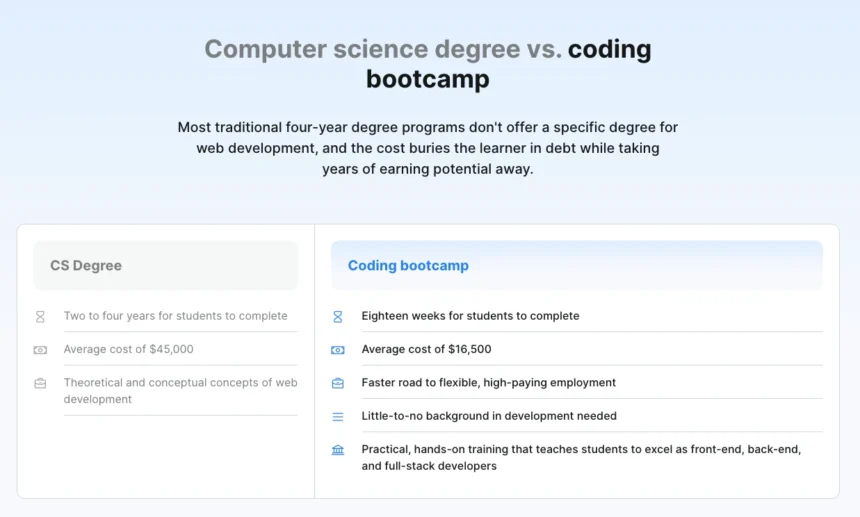
A traditional Bachelor of Science in Computer Science involves a four-year commitment. According to recent 2025 educational data, the total cost of attendance (tuition, fees, and living expenses) for a four-year degree at a public out-of-state or private university ranges significantly but averages approximately $163,140.
However, the “sticker price” is only half the equation. The opportunity cost is substantial. During these four years, a student is generally not earning a full-time income. If we assume a modest potential earning of $30,000 per year in a non-tech role, the foregone income adds another $120,000 to the total economic cost.
- Average Tuition: $40,000 to $200,000+
- Time Commitment: 4 Years
- Curriculum Focus: Algorithms, Data Structures, Operating Systems, Mathematics (Calculus, Linear Algebra), AI Theory.
The Cost of a Coding Bootcamp
Coding bootcamps are designed for speed and efficiency, typically lasting 12 to 24 weeks. The average tuition for a comprehensive full-stack software engineering bootcamp in 2025 sits between $11,800 and $17,980.
The opportunity cost here is lower. A student is out of the workforce for only 3 to 6 months.
- Average Tuition: $12,000 to $20,000
- Time Commitment: 3 to 6 Months
- Curriculum Focus: Practical Application, Web Development (React, Node.js), Version Control (Git), Agile Methodologies.
Salary Showdown: Starting Pay in 2025
The most critical metric for prospective students is the starting salary. Does the prestige of a degree command a premium in the entry-level market?
Computer Science Degree Starting Salaries
Graduates with a CS degree generally command higher starting base salaries, particularly at large tech firms (FAANG/MAMAA companies) that have strict degree requirements for their entry-level cohorts.
- Average Starting Salary: $80,000 to $105,000
- Top Percentile (Big Tech): $120,000+ (Total Compensation including stock options)
Employers value the theoretical depth of a CS degree. Graduates are perceived as having a stronger grasp of foundational concepts like memory management and algorithmic efficiency, which are crucial for scaling complex systems.
Coding Bootcamp Starting Salaries
Bootcamp graduates have proven resilient in the market, though their starting bands are slightly lower. The focus here is often on web development and practical execution rather than theoretical architecture.
- Average Starting Salary: $65,000 to $75,000
- Top Percentile: $90,000+
While the starting salary is lower, the Speed to Income ratio is superior. A bootcamp graduate begins earning a developer’s salary 3.5 years sooner than their university counterpart.
Return on Investment (ROI) Analysis
When we run the numbers over a five-year horizon, the comparison becomes complex.
The Bootcamp Advantage (Short Term):
A bootcamp graduate typically breaks even on their educational investment within 14 to 18 months of employment. By the time a CS student graduates, the bootcamp alumni has already earned three years of salary, potentially totaling over $210,000 in gross earnings before the degree holder has cashed their first paycheck.
The Degree Advantage (Long Term):
The “Career Ceiling” is where the CS degree demonstrates its value. Data suggests that while bootcamps are excellent for breaking into the industry, CS graduates often have a smoother path to Senior Software Engineer, Staff Engineer, and Engineering Management roles.
- 10-Year Earning Potential (CS Degree): $1.5 Million+
- 10-Year Earning Potential (Bootcamp): $1.2 Million
The gap widens in specialized, high-paying fields like Artificial Intelligence, Machine Learning, and Quantum Computing, where a deep mathematical background (rarely taught in bootcamps) is mandatory.
The 2025 Hiring Shift: The “Mid-Level” Junior
A critical trend in the 2025 job market is the disappearance of the true “entry-level” role. Due to the efficiency of Generative AI tools like GitHub Copilot and ChatGPT, companies are hiring fewer juniors to do basic coding tasks.
Recruiters now expect “entry-level” candidates to possess “mid-level” competency. This includes:
- Cloud Proficiency: Knowledge of AWS, Azure, or Google Cloud Platform is no longer optional.
- System Design: Understanding how microservices interact.
- Soft Skills: The ability to communicate technical concepts to non-technical stakeholders.
Impact on Bootcamps:
Bootcamps have had to pivot aggressively. Top-tier programs are now integrating AI-assisted coding and cloud certifications (like the AWS Certified Solutions Architect) into their curriculum to ensure graduates remain competitive.
Impact on Universities:
Universities are slower to adapt curricula but offer internships. A CS student with two summer internships at major tech firms is often the most highly disputed candidate in the market.
High-Paying Niches and Specializations
Regardless of the educational path, specializing in high-demand verticals significantly boosts salary potential.
1. Cybersecurity
With cyber threats escalating, the demand for security professionals is critical.
- Role: Security Engineer / Penetration Tester
- Salary Potential: $120,000 to $160,000
- Key Certifications: CISSP, CEH (Certified Ethical Hacker)
2. Cloud Computing
As organizations migrate legacy systems to the cloud, architects are required to manage this infrastructure.
- Role: Cloud Architect / DevOps Engineer
- Salary Potential: $130,000 to $180,000
- Key Certifications: AWS Certified Solutions Architect, Google Professional Cloud Architect
3. Data Science and AI
This is the highest-paying bracket but also the one with the highest barrier to entry, often requiring a CS degree or even a Master’s/PhD.
- Role: Machine Learning Engineer / Data Scientist
- Salary Potential: $150,000 to $200,000+
Hidden Variables: Geography and Remote Work
Salary figures are heavily dependent on location, although remote work has normalized bands somewhat.
- San Francisco / Silicon Valley: Entry-level salaries often exceed $120,000, but cost of living is exorbitant.
- Austin, Texas: A growing tech hub where $90,000 goes much further.
- Remote: Salaries are increasingly “tiered” based on the employee’s location, but a remote developer can still expect to earn 20-30% more than the local average in non-tech cities.
Verdict: Which Path Should You Choose?
Choose the Computer Science Degree If:
- You are under 25 and have the financial support or scholarship opportunities to fund four years of study.
- You aim to work in deep tech fields like OS development, embedded systems, or AI research.
- You value the “college experience” and the extensive alumni network that prestigious universities offer.
- You want to maximize your career earnings ceiling over a 20+ year period.
Choose the Coding Bootcamp If:
- You are a career changer (age 25+) looking to switch industries rapidly.
- You want to minimize debt and start earning a positive ROI within two years.
- You are interested in practical Web Development or App Development.
- You are a self-starter who can supplement bootcamp training with continuous self-study.
Current Market Analysis (Late 2025)
As of late 2025, the tech job market is stabilizing after the volatility of previous years. While “Big Tech” hiring has slowed for juniors, there is robust demand in the Fintech, Healthcare, and Logistics sectors. These industries are digitizing rapidly and are less sensitive to the “degree vs. bootcamp” distinction, prioritizing demonstrated skill and portfolio quality over pedigree.
Ultimately, the degree gets you the interview, but the skill gets you the job. In 2025, a portfolio containing deployed, full-stack applications using modern technologies (Next.js, TypeScript, Supabase, Tailwind) is the single most effective tool for salary negotiation, regardless of your educational background.
References and Further Reading
- Course Report: Are Coding Bootcamps Worth It in 2025? Link
- BestColleges: Coding Bootcamp vs. Computer Science Degree Link
- Talent500: Entry-Level Developer Jobs: Market Shifts in 2025 Link
- Skillsoft: Top-Paying IT Certifications for 2025 Link
- DigitalDefynd: Coding Bootcamps: Benefits & Job Opportunities [2025] Link