

The digital economy dictates that your infrastructure is the backbone of your revenue. For serious enterprise merchants and rapidly scaling B2B businesses, the choice of a hosting environment for Adobe Commerce, formerly known as Magento, is not merely a technical decision. It is a fundamental business investment that directly correlates with conversion rates, average order value, and long term customer retention. As we navigate the competitive landscape of late 2025, the demand for hyper optimized, secure, and scalable server environments has never been higher.
This comprehensive analysis delves deep into the elite tier of hosting providers that currently dominate the market. We are moving beyond basic shared hosting concepts to explore enterprise grade architecture, cloud scalability, and dedicated resources that power the world’s most successful ecommerce brands. If you are looking to maximize your return on investment and ensure your digital storefront operates with sub second latency, this guide serves as your strategic blueprint.
The Business Case for Premium Infrastructure
Investment in superior hosting architecture is arguably the most critical operational expenditure for an ecommerce entity. Speed is currency. Data from late 2025 indicates that a delay of just one second in page load time can result in a seven percent reduction in conversions. For a platform as resource intensive as Magento, standard hosting environments simply cannot cope with the complex database queries and heavy static content delivery required for a seamless user experience.
High performance hosting provides more than just raw speed. It offers the stability required during high traffic events like Black Friday or flash sales. It ensures rigorous security protocols are in place to protect sensitive customer financial data, a non negotiable requirement in an era of increasing cyber threats. Furthermore, premium providers offer specialized support teams who understand the intricate nuances of the Adobe Commerce stack, acting as an extension of your own IT department. By prioritizing infrastructure, you are effectively purchasing insurance for your revenue stream and laying the foundation for limitless scalability.
Nexcess
Nexcess continues to stand as a titan in the managed Magento hosting space. Their reputation is built on a legacy of innovation and a deep understanding of the platform’s specific resource needs. They do not simply rent server space. They provide a finely tuned ecosystem designed to extract maximum performance from Adobe Commerce applications.
Cloud Accelerator Technology
One of the standout features of Nexcess is their proprietary cloud accelerator. This technology sits in front of the application layer and optimizes the delivery of static assets. It works in tandem with Nginx and Varnish to ensure that the heavy lifting is done by the server’s cache rather than the PHP workers. This results in a drastic reduction in time to first byte (TTFB), which is a crucial metric for both user experience and search engine ranking.
Auto Scaling Capability
Traffic spikes are a sign of success, but they can be a nightmare for unprepared infrastructure. Nexcess addresses this with their auto scaling feature. The platform monitors concurrency and resource usage in real time. When a surge is detected, the system automatically deploys additional PHP resources to handle the load. This elasticity ensures that your checkout process remains fluid even when thousands of customers are browsing simultaneously. For enterprise clients, this capability eliminates the need to pay for maximum capacity around the clock, offering a smart balance between performance and operational cost.
Security and Compliance
For B2B and B2C merchants, security is paramount. Nexcess provides a PCI compliant hosting environment, which is essential for any business processing credit card transactions. Their proactively managed security includes daily malware scans and a web application firewall (WAF) that filters out malicious traffic before it reaches your store. This multi layered approach to security protects your brand reputation and ensures business continuity.
Cloudways
Cloudways has revolutionized the market by acting as a bridge between complex cloud infrastructure and the end user. They offer a unique proposition that allows businesses to deploy Magento applications on top of world class infrastructure providers like Amazon Web Services (AWS), Google Cloud Platform (GCP), and DigitalOcean, without the steep learning curve associated with managing raw cloud servers.
Flexibility and Choice
The primary strength of Cloudways lies in its agnostic approach to infrastructure. Merchants are not locked into a single physical data center. Instead, they can choose the underlying provider that best suits their geographic needs and budget. For a global enterprise, this means you can host your store on an AWS data center in Northern Virginia to serve US customers while simultaneously running a European storefront on a Google Cloud server in Frankfurt. This level of geographic targeting minimizes latency and ensures compliance with local data sovereignty regulations.
Optimized Tech Stack
Cloudways utilizes a specialized technology stack known as ThunderStack. This combination includes Nginx, Apache, Memcached, MySQL or MariaDB, Varnish, and Redis. Each component is configured to work in harmony, reducing database bottlenecks and accelerating page rendering. Redis, in particular, plays a critical role in managing Magento’s session storage and cache backend, significantly improving the responsiveness of the admin panel and the checkout flow.
Cost Efficiency
The pay as you go pricing model offered by Cloudways is particularly attractive for growing businesses. Unlike traditional dedicated hosting where you pay a fixed monthly fee regardless of usage, Cloudways allows you to scale your server resources up or down based on demand. This granular control over expenditure enables precise budget management and ensures that capital is directed towards growth initiatives rather than idle server capacity.
SiteGround
While often recognized for its dominance in the WordPress sector, SiteGround has carved out a significant niche in the enterprise ecommerce market with its cloud hosting solutions. Their offering is built entirely on the Google Cloud infrastructure, providing merchants with the same network reliability and speed that powers Google’s own services.
Google Cloud Infrastructure
Leveraging the premium tier of Google’s network gives SiteGround users a distinct advantage. The low latency connections and high throughput of Google’s fiber network ensure that data travels the fastest possible path to the user. This is complemented by distributed SSD storage, which offers superior input and output operations per second (IOPS) compared to traditional spinning hard drives or standard SSDs. For a database heavy application like Magento, high IOPS is critical for fast query execution and inventory updates.
Custom Collaboration Tools
SiteGround focuses heavily on the workflow of development teams. Their platform includes tools that facilitate seamless staging and deployment. The ability to create a staging copy of your store with a single click allows developers to test new extensions, code changes, or theme updates in a safe environment before pushing them to production. This minimizes the risk of downtime caused by incompatible code and streamlines the development lifecycle.
Managed Service Excellence
The “managed” aspect of SiteGround’s cloud hosting is comprehensive. Their team handles the configuration of the OS, the web server, and the database, allowing the merchant to focus on sales and marketing. Their proactive monitoring system checks the server status every half second, often identifying and resolving issues before the store owner is even aware of them. This level of vigilance is invaluable for businesses where every minute of downtime translates to lost revenue.
A2 Hosting
For merchants where raw speed is the singular priority, A2 Hosting presents a compelling case. They have positioned themselves as the speed focused provider, utilizing hardware optimizations to squeeze every millisecond of performance out of their servers.
Turbo Server Technology
The crown jewel of A2 Hosting is their Turbo Server platform. These servers are designed to be a drop in replacement for standard Apache setups but are engineered to handle connections much faster. They claim to offer page loads up to twenty times faster than competing standard hosting. This is achieved through a combination of limited occupancy on shared resources and advanced caching mechanisms that store HTML versions of pages in memory, bypassing the PHP processing layer entirely for repeat visits.
NVMe Storage Implementation
A2 Hosting was among the early adopters of Non Volatile Memory Express (NVMe) storage for their higher tier plans. NVMe drives offer read and write speeds that are exponentially faster than traditional SATA SSDs. In the context of Adobe Commerce, this translates to faster reindexing operations, quicker product import and export processes, and snappier database response times. For stores with massive catalogs containing hundreds of thousands of SKUs, NVMe storage can significantly reduce the time required for backend administrative tasks.
Developer Friendly Environment
A2 Hosting caters to the technical user. They provide root access on their VPS and dedicated plans, giving system administrators complete control over the server environment. This allows for the installation of custom software, specific PHP extensions, or specialized database configurations that might be restricted on more locked down managed platforms.
MGT Commerce
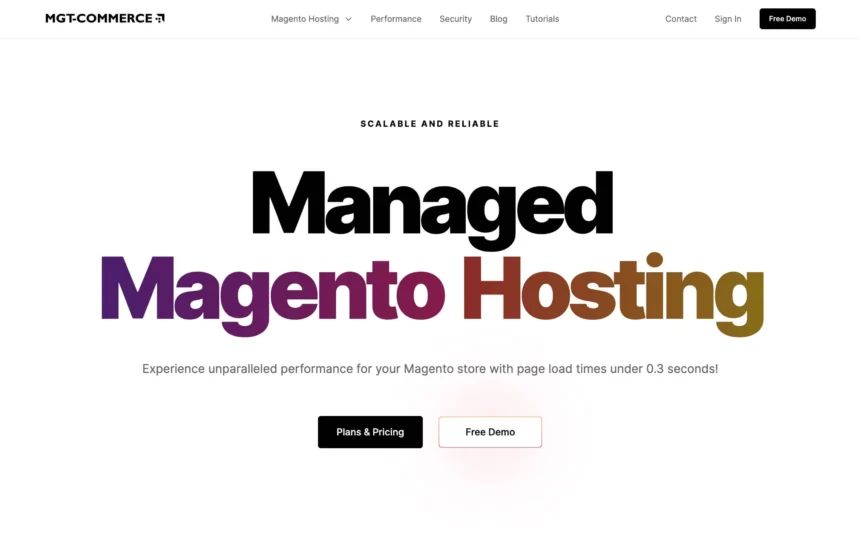
When discussing high end enterprise hosting specifically for Magento, MGT Commerce is a name that commands respect. They specialize exclusively in high performance cloud hosting solutions on Amazon Web Services.
AWS Managed Services
MGT Commerce takes the complexity of AWS and simplifies it for the Magento merchant. They utilize the full spectrum of AWS services, including EC2 for computing power, RDS for scalable databases, and ElastiCache for Redis and Memcached. By architecting the environment specifically for Magento, they achieve load times that are consistently under half a second.
Varnish Cache Optimization
Their expertise in configuring Varnish Cache is a major differentiator. Varnish is an HTTP accelerator designed for content heavy dynamic websites. When properly configured, it can serve cached content hundreds of times faster than the application server. MGT Commerce provides a pre configured Varnish setup that works seamlessly with Magento, handling complex scenarios like hole punching for dynamic blocks such as the shopping cart and customer welcome messages.
MGT Control Panel
To manage this complex infrastructure, they provide a proprietary control panel. This interface allows store owners to manage server settings, view logs, and deploy SSL certificates without needing to log in to the AWS console. It bridges the gap between the raw power of the cloud and the usability required by ecommerce managers.
Technical Considerations for 2025
Selecting a provider is only the first step. Understanding the technical requirements of a modern Adobe Commerce installation is essential for facilitating a productive conversation with your potential host.
Elasticsearch and OpenSearch
As of 2025, the default search engine for Adobe Commerce is OpenSearch, having transitioned from Elasticsearch. Your hosting provider must support the latest versions of these search technologies. They are responsible for powering the catalog search, category filters, and related product suggestions. A hosting environment that runs the search engine on a separate dedicated node or container is preferable, as it prevents search queries from consuming resources needed for the web server or database.
Redis and Varnish
These two technologies are no longer optional extras but mandatory components for a performant store. Redis is used for object caching and session storage, preventing the database from being overwhelmed by simple read and write operations. Varnish serves as a full page cache. Ensure that your hosting plan includes ample memory (RAM) to support large Redis and Varnish instances. If the memory is insufficient, the system will swap to disk, causing severe performance degradation.
PHP Workers and Concurrency
The number of PHP workers assigned to your plan determines how many uncached requests your store can handle simultaneously. This is the bottleneck for dynamic actions like adding to cart, checkout, and customer login. Enterprise plans should offer a generous allocation of PHP workers or the ability to auto scale them during traffic peaks. Insufficient workers will result in 503 errors and lost sales during your busiest periods.
Content Delivery Networks (CDN)
In a global marketplace, latency is determined by physical distance. A robust CDN integration is non negotiable. Whether it is Cloudflare, Fastly, or a proprietary solution, the CDN caches static assets like images, CSS, and JavaScript on servers located near the user. Premium hosting providers often include an enterprise tier CDN with their plans, offering advanced features like image optimization and DDoS mitigation at the edge.
Server Location and Data Sovereignty
With tightening data privacy regulations globally, the physical location of your data matters. Hosting providers with a global footprint of data centers allow you to host your customer data within the legal jurisdiction of your target market. This is crucial for compliance with GDPR in Europe, CCPA in California, and other emerging privacy standards.
The Role of Dedicated Resources
For B2B merchants and high volume B2C retailers, shared resources are a liability. Dedicated servers or dedicated cloud instances ensure that your store’s performance is never impacted by the activities of other neighbors on the server. “Noisy neighbor” issues can cause sporadic slowdowns that are difficult to diagnose. Dedicated resources guarantee consistent CPU availability and disk I/O, providing a stable foundation for business growth.
Investment Strategy and ROI
When evaluating the cost of these premium hosting solutions, it is imperative to shift the mindset from “expense” to “investment.” A cheap hosting plan that saves fifty dollars a month but causes a two percent drop in conversion due to slow load times is costing the business thousands of dollars in lost revenue.
Consider the Total Cost of Ownership (TCO). This includes not just the monthly hosting fee, but the cost of developer time spent debugging server issues, the cost of lost sales during downtime, and the reputational damage of a slow website. Premium managed hosting reduces the burden on your internal team, allowing them to focus on feature development and user experience improvements rather than server maintenance.
Future Proofing Your Infrastructure
The ecommerce landscape is evolving towards headless architecture and Progressive Web Apps (PWA). These technologies decouple the frontend from the backend, requiring a hosting environment that can support API heavy traffic patterns. Leading providers are already optimizing their stacks for PWA Studio and other headless frontends, ensuring that your investment today is ready for the technological shifts of tomorrow.
Furthermore, the integration of Artificial Intelligence into ecommerce operations places new demands on infrastructure. AI driven personalization engines and customer analytics require significant processing power and rapid data access. Hosting environments with high performance compute instances and scalable databases are best positioned to leverage these emerging tools for competitive advantage.
Final Strategic Recommendations
The selection of a hosting partner for Adobe Commerce is a high stakes decision. The market in late 2025 offers powerful options tailored to different business needs.
For the enterprise seeking a hands off, fully managed experience with white glove support, Nexcess remains the gold standard. Their auto scaling capabilities and security posture make them a safe bet for high revenue stores.
For the agile business that desires the power of the public cloud with the flexibility of a managed platform, Cloudways offers an unbeatable value proposition. The ability to choose between AWS, Google, and others provides strategic versatility.
For those deeply integrated into the Google ecosystem and prioritizing network speed, SiteGround offers a robust and reliable solution.
For the performance purist who demands the absolute fastest hardware specs, A2 Hosting’s NVMe and Turbo Server offerings provide raw speed that is hard to match.
For the large scale organization requiring a bespoke AWS architecture, MGT Commerce delivers a level of specialization that generalist hosts cannot replicate.
Your digital storefront is your most valuable asset. Do not build it on a foundation of sand. rigorous due diligence in selecting your hosting provider is the first step toward building a resilient, high performing, and profitable ecommerce business.
Sources
- Nexcess Enterprise Hosting https://www.nexcess.net/magento/
- Cloudways Managed Cloud https://www.cloudways.com/en/magento-hosting.php
- SiteGround Cloud Solutions https://www.siteground.com/cloud-hosting.htm
- A2 Hosting Turbo Plans https://www.a2hosting.com/magento-hosting
- MGT Commerce AWS Solutions https://www.mgt-commerce.com/
- Adobe Commerce Technical Requirements https://business.adobe.com/products/magento/magento-commerce.html
- Google Cloud Platform Network Tier Information https://cloud.google.com/network-tiers
- Varnish Cache Documentation https://varnish-cache.org/
- OpenSearch Project https://opensearch.org/
- Redis Documentation https://redis.io/
- Elementor Ecommerce Trends 2025 https://elementor.com/blog/ecommerce-trends/
- BigCommerce Ecommerce Trends https://www.bigcommerce.com/articles/ecommerce/ecommerce-trends/