
The digital infrastructure landscape of 2025 is a battlefield of efficiency, security, and raw computational power. For Chief Technology Officers, DevOps engineers, and serious digital entrepreneurs, the debate between Cloud Virtual Private Servers (VPS) and Dedicated Server Hosting has evolved from a simple question of cost to a complex strategic decision involving AI workloads, cybersecurity compliance, and latency-sensitive applications.
- The Evolution of Hosting: Where We Stand in 2025
- Performance Analysis: The Raw Compute Reality
- The Security Imperative: Zero Trust and Isolation
- The Financial Argument: CapEx vs. OpEx
- Critical Switch Points: When to Migrate
- 1. The High Traffic Threshold
- 2. The AI and Machine Learning Pivot
- 3. Regulatory Compliance Requirements
- 4. Custom Kernel and Hypervisor Needs
- Hybrid Solutions: The Best of Both Worlds
- Choosing the Right Provider in 2025
- Future Outlook: Beyond 2025
- Conclusion: Take Back Control
While the cloud revolution defined the last decade by offering unprecedented scalability, the current year has seen a massive resurgence in Bare Metal Server adoption. This shift is driven by the need for performance predictability and the rising costs of hyperscale cloud services. In this comprehensive guide, we will dissect the technical realities of enterprise cloud infrastructure, analyze the total cost of ownership, and pinpoint the exact moment your organization must migrate from a virtualized environment to single-tenant hardware.
The Evolution of Hosting: Where We Stand in 2025
The hosting industry has matured significantly. Cloud computing trends for 2025 indicate a move away from “cloud-only” strategies toward “smart-cloud” or hybrid cloud strategies. The market is no longer about choosing one over the other blindly but about placing the right workload on the right infrastructure.
The Modern Cloud VPS Landscape
Cloud VPS technology has advanced rapidly. Modern virtualization hypervisors have reduced overhead to negligible levels for general-purpose computing. With the integration of containerization technologies like Kubernetes and Docker, a Cloud VPS is the default starting point for 90% of new applications.
The primary appeal remains scalable computing resources. In a Cloud VPS environment, you can scale your CPU cores and RAM up or down with an API call. This elasticity is perfect for startups, testing environments, and applications with unpredictable traffic spikes.
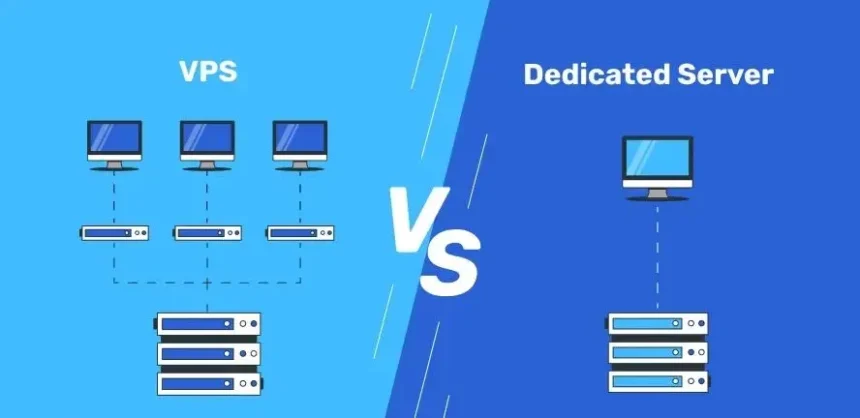
However, the “noisy neighbor” effect remains a physical reality. Even with advanced isolation, your virtual machine shares physical resources like the L3 cache, memory bandwidth, and storage I/O with other tenants. For high traffic websites or data-intensive applications, this resource contention can lead to micro-stutters and unpredictable latency.
The Renaissance of Bare Metal Servers
Bare metal servers are physical servers dedicated to a single tenant. There is no hypervisor layer between your operating system and the hardware. In 2025, this is not just about nostalgia for old hardware; it is about accessing the raw power of modern silicon.
New processor lines like the AMD EPYC 9000 series and Intel Xeon Scalable processors offer core counts that were unimaginable five years ago. A single bare metal server can now host hundreds of virtual machines or power massive AI model training clusters.
The market has shifted towards automated bare metal. Providers now offer the ability to provision a physical server in minutes via API, blurring the line between the flexibility of the cloud and the power of hardware. This “Metal-as-a-Service” model is a key driver in the current infrastructure boom.
Performance Analysis: The Raw Compute Reality
When performance is the only metric that matters, bare metal is the undisputed king. To understand why, we must look at the bottlenecks.
CPU Ready Time and Interrupts
In a virtualized environment, the vCPU (virtual CPU) assigned to your instance is a thread scheduled on a physical core. The hypervisor manages this scheduling. When your application needs to process a request, it must wait for the hypervisor to allocate a physical cycle. This wait time is called “CPU Ready Time.”
For a standard web server, this delay is imperceptible. For high-frequency trading (HFT) platforms, real-time gaming servers, or VoIP services, even milliseconds of delay can result in service degradation. Dedicated server hosting eliminates this scheduling layer. Your kernel talks directly to the CPU.
Storage I/O and NVMe Performance
Storage has historically been the biggest bottleneck in computing. The introduction of NVMe storage (Non-Volatile Memory Express) has solved this for local hardware, but cloud storage introduces network latency.
Most Cloud VPS solutions use network-attached storage (Block Storage). Every time your database writes to the disk, that data travels over a network fabric to a storage cluster. In contrast, a bare metal server with local NVMe drives utilizes the PCIe bus directly.
Recent benchmarks in 2025 show that local NVMe on bare metal can deliver upwards of 1 million IOPS (Input/Output Operations Per Second) with varying queue depths. Comparable performance on a public cloud would require expensive “provisioned IOPS” tiers that can triple your monthly bill.
Network Throughput and Bandwidth
Unmetered bandwidth is a staple of the dedicated server market. In the cloud ecosystem, bandwidth is often the hidden killer. Egress fees (the cost of data leaving the cloud) can bankrupt a media streaming service or a content delivery network.
Dedicated servers usually come with massive port speeds (10Gbps, 25Gbps, or even 100Gbps) and generous data allowances. If you are running a video transcoding service or a large file repository, the economics of bandwidth alone will force a switch to bare metal.
The Security Imperative: Zero Trust and Isolation
Cybersecurity trends in 2025 are dominated by the concept of Zero Trust Architecture. This security model assumes that threats exist both inside and outside the traditional network perimeter.
Single-Tenant vs. Multi-Tenant
The fundamental security flaw of Cloud VPS is multi-tenancy. You are trusting the cloud provider’s hypervisor to keep your data separate from the potentially malicious actor on the same physical machine. While hypervisor breakouts are rare, they are not impossible. Meltdown and Spectre vulnerabilities showed us that hardware-level exploits can bridge the gap between virtual machines.
Bare metal servers offer physical isolation. You are the only tenant on the box. This is often a mandatory requirement for industries governed by strict regulations like HIPAA (Health Insurance Portability and Accountability Act) in healthcare or PCI-DSS for payment processing.
Hardware Root of Trust
Modern dedicated servers come with TPM 2.0 (Trusted Platform Module) chips and hardware capabilities that allow for a “Hardware Root of Trust.” You can verify that the server’s firmware has not been tampered with before your operating system even boots. Implementing this level of supply chain security is significantly more complex in a virtualized public cloud environment where you do not have visibility into the underlying hardware.
DDoS Protection and Mitigation
Distributed Denial of Service (DDoS) attacks have grown in scale and complexity. In 2025, attacks exceeding 1 Tbps are becoming common.
While cloud providers offer robust DDoS protection, it is often a shared pool of mitigation. If a massive attack hits a neighbor in your availability zone, your services might suffer collateral damage. With a dedicated server, you can deploy custom hardware firewalls or specialized inline DDoS mitigation appliances that are tuned specifically to your traffic patterns. This granular control is essential for maintaining uptime during targeted attacks.
The Financial Argument: CapEx vs. OpEx
The financial conversation around hosting has shifted. Initially, the cloud was sold as a way to reduce CapEx (Capital Expenditure) and move to OpEx (Operational Expenditure). However, the “pay-as-you-go” model has proven to be a double-edged sword.
The Cloud Bill Shock
Cloud costs are linear or sometimes exponential. As your traffic grows, your bill grows. There are costs for compute, costs for storage, costs for bandwidth, costs for load balancers, and costs for static IP addresses.
For a stable, predictable workload, the cloud is often 3 to 5 times more expensive than renting a dedicated server.
Dedicated Server Pricing Trends
Managed dedicated server hosting pricing trends in 2025 show a stabilization of hardware costs.
- Entry-Level: You can secure a capable bare metal server (e.g., Intel Xeon E-2300 series, 32GB RAM) for roughly $60 to $120 per month.
- Mid-Range: A powerhouse machine (e.g., Dual Xeon Gold or AMD EPYC, 128GB RAM) typically falls in the $200 to $350 per month range.
- High-End: Enterprise-grade clusters with 1TB+ RAM and GPU acceleration can range from $500 to $2,000+ per month.
The key differentiator is that these are flat fees. If you push 50TB of traffic through your dedicated server, your bill remains $200. If you push 50TB of traffic through a major public cloud provider, your bandwidth bill alone could exceed $4,000.
FinOps and Cost Predictability
FinOps (Financial Operations) teams are increasingly pushing for repatriation; moving workloads from the cloud back to on-premise or colocation facilities. A dedicated server rental acts as a middle ground. You get the predictability of a fixed monthly invoice without the capital expense of buying hardware and managing a data center.
Critical Switch Points: When to Migrate
Knowing the theory is good, but when do you actually pull the trigger? Here are the specific scenarios where switching to bare metal is not just an option but a necessity.
1. The High Traffic Threshold
If your website or application consistently utilizes more than 16 vCPUs and 64GB of RAM, you have likely crossed the cost-efficiency threshold. At this scale, a dedicated server will almost always provide better performance per dollar.
Additionally, if your application handles thousands of concurrent database connections, the IOPS stability of local NVMe storage on bare metal is non-negotiable.
2. The AI and Machine Learning Pivot
AI workloads are the defining feature of 2025’s tech landscape. Training machine learning models requires massive parallel processing power.
Virtualizing a GPU (Graphics Processing Unit) adds significant overhead. For training Large Language Models (LLMs) or complex inference tasks, you need direct access to the GPU hardware (like NVIDIA H100s or A100s). Bare metal servers configured with high-end GPUs allow for direct memory access (DMA) and peer-to-peer transfers between cards, drastically reducing training time.
3. Regulatory Compliance Requirements
If you are expanding into markets with strict data sovereignty laws (such as the EU’s GDPR or California’s CPRA), you need to know exactly where your data physically resides.
In a public cloud, data can float between different physical hosts within a region. With a dedicated server, you can point to a specific rack in a specific data center in Frankfurt, London, or New York and say, “That is where my data lives.” This level of auditability is often required for banking, legal, and government contracts.
4. Custom Kernel and Hypervisor Needs
Developers working on deep systems programming often need to modify the OS kernel. In a Cloud VPS, you share the kernel with the host (in container setups) or are restricted by the hypervisor’s supported drivers.
On bare metal, you can run any operating system you want. You can install a Type-1 hypervisor like Proxmox or ESXi and create your own private cloud. You can tweak kernel parameters for specialized networking protocols. You have root access to the hardware itself.
Hybrid Solutions: The Best of Both Worlds
It is rarely an all-or-nothing decision. The most resilient architectures in 2025 are hybrid.
The Database on Metal, App on Cloud Strategy
A common high-performance pattern involves hosting the database layer on a massive dedicated server to ensure data integrity and I/O speed, while running the application frontend on a fleet of Cloud VPS instances that can auto-scale during traffic spikes.
This setup utilizes private networking (VLANs) to connect the dedicated database securely to the cloud instances, offering the reliability of metal with the elasticity of the cloud.
Disaster Recovery and Backup
Another strategy is using a dedicated server as a robust backup repository. With massive storage capacity (e.g., 100TB+ HDD arrays) being cheaper on dedicated hardware, you can replicate your expensive cloud data to a secure bare metal server for disaster recovery and long-term archiving.
Choosing the Right Provider in 2025
Selecting a dedicated server hosting provider is different from picking a cloud vendor. You are not just buying credits; you are renting hardware.
Hardware Transparency
Look for providers that list specific CPU models (e.g., “AMD EPYC 9354”) rather than generic terms like “24 vCPUs.” You need to know the generation of the processor to understand its efficiency and performance.
Network Quality (The Carrier Blend)
Ask about the provider’s “network blend.” Premium providers utilize a mix of Tier-1 carriers (like Lumen, Telia, NTT, and GTT) to ensure the best routing for global traffic. Budget providers might rely on a single, congested upstream provider.
Support and Managed Services
“Unmanaged” means you are on your own. If the server is online but your Apache web server is broken, that is your problem. Managed dedicated server plans include support teams that will handle security patching, monitoring, and proactive hardware replacement. For businesses without a 24/7 sysadmin team, managed support is worth every penny.
Future Outlook: Beyond 2025
As we look toward 2030, the line between cloud and metal will continue to blur. We are seeing the rise of “ephemeral bare metal”; physical servers that spin up for a specific task and shut down, billed by the second.
We also anticipate the integration of Quantum-safe cryptography chips directly into server motherboards to prepare for the post-quantum era. Edge computing will drive the deployment of smaller, ruggedized bare metal servers to cell towers and regional hubs to process data closer to the source (IoT devices and autonomous vehicles).
Conclusion: Take Back Control
The decision to switch from Cloud VPS to a Bare Metal Server is a milestone in your organization’s growth. It signifies that your traffic is significant, your data is critical, and your need for performance has outgrown the “one-size-fits-all” convenience of virtualization.
While the cloud offers an easy entry point, bare metal delivers the mastery. It provides the isolation, the raw power, and the cost control necessary to scale a serious digital business in 2025.
If your monthly cloud bill is rising while your performance is stagnating, do not just upgrade to the next tier of virtual instances. Audit your infrastructure. Calculate the cost per core. You will likely find that the hardware you need is waiting for you in a rack, ready to be unleashed.