

The decentralized world of Web3, powered by smart contracts, has revolutionized finance, gaming, and governance. These self-executing, immutable pieces of code are the economic engine of a trillion-dollar ecosystem. Yet, their very nature their immutability makes them uniquely vulnerable. Once deployed, a bug is a permanent, exploitable flaw. In the first half of 2025 alone, over $2.093 billion was lost to exploits and hacks in the Web3 sector, with the vast majority stemming from contract vulnerabilities.
- The Unforgiving Nature of Smart Contract Vulnerabilities
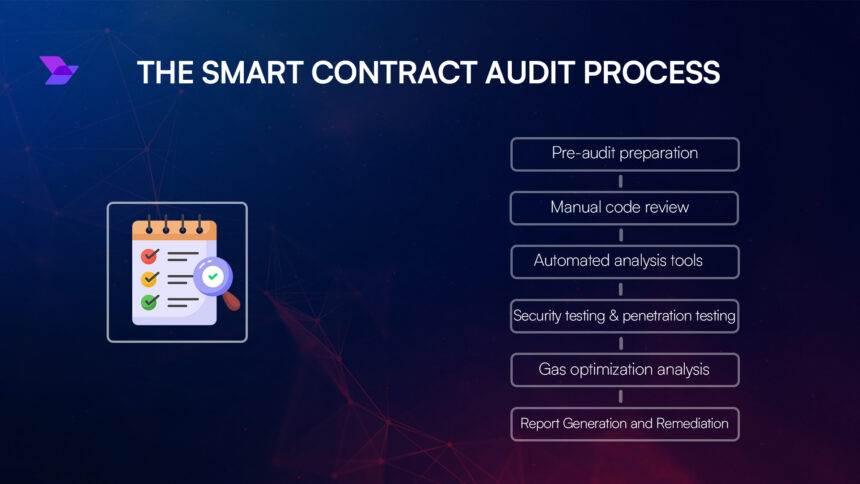
- The Smart Contract Audit Process: A Multi-Layered Defense
- Phase 1: Automated Static Analysis
- Phase 2: Manual Code Review and Business Logic Analysis
- Phase 3: Dynamic Analysis and Fuzz Testing
- Phase 4: Formal Verification
- Selecting a Top Smart Contract Auditing Service
- Beyond the Audit: Web3 Security in the Regulatory Age
- Conclusion: Security is a Continuous Process
This profound financial risk has elevated smart contract auditing services from a mere best practice to an absolute requirement. A comprehensive audit is the only reliable insurance against catastrophic losses, protecting user funds, investor trust, and the long-term viability of decentralized projects. For anyone building or investing in the Web3 space, understanding the audit landscape is the key to managing risk.
The Unforgiving Nature of Smart Contract Vulnerabilities
The complexity of modern decentralized applications (dApps) means that a simple logic error or oversight can lead to an exploit that drains millions of dollars in moments. The 2025 security landscape is dominated by sophisticated attack vectors, many of which are modern variations of old, familiar flaws.
Top Smart Contract Vulnerabilities in 2025
Auditors consistently flag these critical weaknesses as the source of major financial incidents:
- Logic Flaws and Business Logic Errors: These are the leading cause of loss, accounting for $356 million in damages in the first half of 2025. These are not syntax errors, but failures where the code operates exactly as written, but not as intended by the project’s whitepaper. Examples include flaws in token minting, reward distribution formulas, or incorrect state transitions in complex DeFi protocols.
- Reentrancy Attacks: Despite being a known issue since The DAO hack in 2016, reentrancy still occurs, exploiting a contract that makes an external call before updating its internal state. This allows an attacker to recursively call the withdrawal function, repeatedly draining funds. The Checks-Effects-Interactions pattern remains the primary defense.
- Access Control Failures: This remains the most frequent point of failure, often resulting from missing or flawed permission checks. Using
tx.origininstead ofmsg.senderor failing to correctly implement role-based access control (RBAC) can allow unauthorized users to seize control of critical admin functions, such as upgrades or emergency shutdowns. - Price Oracle Manipulation: Essential for DeFi, price oracles feed external market data into smart contracts. Attackers utilize flash loans to temporarily manipulate the price of a token on a decentralized exchange (DEX), fooling the oracle or the contract into executing transactions at an artificially inflated or deflated price, leading to massive arbitrage profits.
- Upgrade Mechanism Vulnerabilities: Over 35% of deployed contracts now use proxy patterns for upgradability. Flaws in the proxy’s control mechanism, such as a missing time-lock or compromised admin key, allow attackers to push a malicious contract upgrade and steal locked assets, as seen in a high-profile $70 million exploit in April 2025.
These statistics underscore a crucial reality: approximately 70% of major exploits in 2024 came from smart contracts that had already undergone an audit. This highlights the structural limitations of traditional, rushed auditing and the necessity for a multi-layered security approach.
The Smart Contract Audit Process: A Multi-Layered Defense
A reputable smart contract audit is far more than a simple automated scan. It is a deep, time-intensive investigation that combines human expertise with state-of-the-art tooling.
Phase 1: Automated Static Analysis
This initial phase uses advanced tools like Slither and Mythril to quickly scan the contract’s source code and Ethereum Virtual Machine (EVM) bytecode for common, well-known vulnerabilities.
- Static Analysis: The code is analyzed without being run. Tools check for reentrancy patterns, improper access control modifiers, use of deprecated Solidity features, and potential gas inefficiencies. This provides a baseline code health score.
- Linter Integration: Tools like Solhint ensure code adherence to secure coding standards. While not a vulnerability finder, clean, standardized code is inherently less prone to human error.
Phase 2: Manual Code Review and Business Logic Analysis
This is the most critical phase, where experienced auditors spend hours reviewing every line of code. They are hunting for complex, subtle flaws that automated tools miss, particularly business logic errors.
- Threat Modeling: The auditor simulates potential attack paths based on the protocol’s specific design. If it is a lending protocol, they focus on collateralization ratios and liquidation logic. If it is a decentralized autonomous organization (DAO), they focus on governance voting mechanisms.
- In-Depth Logic Review: Auditors verify that the code implements the logic described in the whitepaper and documentation exactly as intended, paying close attention to tokenomics, reward accrual, and edge-case handling (e.g., zero-value transfers, maximum limits, rounding precision). Logic flaws are detected by expert human review over 90% of the time compared to automated scans.
Phase 3: Dynamic Analysis and Fuzz Testing
This phase involves running the smart contract code in a controlled environment to see how it behaves under stress.
- Fuzzing: Tools like Echidna feed the contract with large volumes of randomized, unexpected input data to discover crashes, unexpected reverts, or unintended state changes. This is highly effective at uncovering arithmetic flaws and input validation failures.
- Unit and Integration Testing: Auditors verify that the project’s existing test suite is comprehensive and, often, add their own adversarial tests to cover boundary conditions and critical execution paths.
Phase 4: Formal Verification
For high-value, critical contracts in DeFi, Formal Verification (FV) offers the highest level of assurance. This technique uses mathematical proofs to guarantee that the smart contract code adheres to its formal specifications under all possible conditions.
- Mathematical Proof: Instead of testing a finite number of scenarios, FV proves that certain safety properties (e.g., “The total token supply will never increase unexpectedly”) are mathematically true for all possible inputs and states.
- Advanced Tools: Systems like the Certora Prover are used by protocols like Aave and Uniswap to provide an absolute guarantee of correctness, virtually eliminating entire classes of vulnerabilities. While costly and complex, FV is a non-negotiable step for applications securing billions in assets.
Selecting a Top Smart Contract Auditing Service
The choice of an auditing firm is an investment in security and reputation. Projects seek out firms that have demonstrably secured billions of dollars in assets and possess deep, up-to-date knowledge of the Web3 attack landscape.
Leading Smart Contract Auditing Firms in 2025
| Auditing Firm | Primary Focus/Specialization | Noteworthy Clients Secured | Key Service Differentiator |
| CertiK | Security Audits, Skynet Monitoring, KYC | Binance, Polygon, AAVE | AI-Powered Audit and Continuous Monitoring Services |
| ConsenSys Diligence | Ethereum-Ecosystem, Developer Tools | Ethereum Foundation, Uniswap, Chainlink | Deep expertise in Solidity, offers security tools like Fuzzing and Scribble |
| OpenZeppelin | Audits, Secure Libraries, Defender | Aave, Compound, MakerDAO | Pioneer of secure smart contract libraries, highly trusted in the ecosystem |
| Hacken | Smart Contract Audits, Bug Bounty Programs | Avalanche, VeChain, Gate.io | Extensive bug bounty community integration, strong in pen-testing |
| Trail of Bits | Deep Cybersecurity, Government-Grade Security | Prominent US Government Agencies, Crypto Protocols | Highly technical, known for advanced security research and open-source tools |
The Cost of Assurance
The price of a smart contract audit reflects the complexity of the code, the scope of the features, and the caliber of the auditors. Do not choose an auditor based on the lowest quote.
- Small, Simple Contract (e.g., ERC-20 token): The cost can range from $5,000 to $15,000, requiring 1 to 2 weeks.
- Medium Complexity dApp (e.g., simple NFT marketplace): Expect costs between $20,000 and $50,000, requiring 2 to 4 weeks.
- High Complexity DeFi Protocol (e.g., sophisticated lending or perpetuals platform): Audits can easily exceed $100,000 to $300,000, spanning 4 to 8 weeks, especially if formal verification or extensive cryptoeconomic analysis is included.
The investment is minimal compared to the potential loss. A logic flaw costing $356 million in a year dwarfs a $100,000 audit fee.
Beyond the Audit: Web3 Security in the Regulatory Age
The regulatory environment is rapidly catching up to the technology. As the European Union’s MiCA (Markets in Crypto Assets) framework rolls out, and the US moves toward stablecoin regulation, audits are becoming a compliance requirement, not just a security measure.
The Role of Continuous Monitoring
The traditional audit is a snapshot in time. Any code changes, external contract dependencies, or changes in the blockchain environment can introduce new vulnerabilities after the audit is complete.
- Real-Time Monitoring: Tools like Forta and Tenderly are essential for post-deployment security. They use decentralized network of “bots” that monitor on-chain events in real-time, detecting suspicious activity, flash loan transactions, or abnormal withdrawal patterns within seconds. This allows protocols to activate emergency shutdown procedures (pausing) before a full exploit can occur.
- Governance and Time-Locks: Best-in-class projects use multi-signature wallets (Multi-Sig) and time-locks for critical actions, such as upgrading the core contract. A time-lock delays the execution of a privileged transaction, giving the community or monitoring tools a window to detect and prevent a malicious update.
The Future: AI-Powered Auditing
The trend for 2025 and beyond is the integration of Artificial Intelligence (AI) into the security workflow. AI-driven tools are improving their capability to analyze smart contract code faster than any human, using machine learning to adapt to emerging threat patterns. While human experts remain indispensable for verifying findings and analyzing complex business logic, AI is speeding up the initial triage and identification of common flaws, making the overall audit process more efficient and thorough.
Conclusion: Security is a Continuous Process
The journey to secure a decentralized application does not end with a single smart contract audit. It is a continuous, multi-faceted commitment that spans the entire lifecycle of the project.
For developers and project leads, the directive is clear: embrace secure development practices from day one, utilize established and audited libraries like OpenZeppelin, budget for a comprehensive, multi-phased audit from a top-tier firm, and implement robust, real-time monitoring and governance safeguards.
The high-value nature of the assets secured by smart contracts ensures that they will remain a prime target for sophisticated attackers. By prioritizing expert smart contract auditing and layered security measures, projects can confidently avoid costly hacks, safeguard user capital, and build the trust necessary for the mass adoption of the decentralized future.